Saturday, May 10, 2014

The Myth of John Johanna


In 1966, Bob Dylan was interviewed by Playboy. Over that past year or so he had been involved in a lot of controversy and acrimony over his embrace of rock music.The folk music scene viewed the move as nothing short of treasonous. Naturally, the interview touched on Dylan's view of folk music.

Songs like "Which Side Are You On?" and "I Love You, Porgy" - they're not folk-music songs; they're political songs. They're already dead. Obviously, death is not very universally accepted."

Don't get me wrong, I think that Which Side Are You On is a brilliant song, and in my opinion, one of the finest examples of political/propaganda songs ever written. However, it is lacking a certain timeless quality, and it is this quality that Dylan found in what he termed traditional music.

There's nobody that's going to kill traditional music. All these songs about roses growing out of people's brains and lovers who are really geese and swans that turn into angels - they're not going to die."

The music packs an emotional punch because it is  

[T]oo unreal to die. It doesn't need to be protected. Nobody's going to hurt it. In that music is the only true, valid death you can feel today off a record player."

Dylan called it "plain simple mystery," and identified another significant aspect of the music's timelessness- myth.

It comes about from legends, Bibles, plagues, and it revolves around vegetables and death.[1]

In a earlier interview, Dylan expanded on this mythic aspect of folk/traditional music.

There is--and I'm sure nobody realizes this, all the authorities who write about what it is and what it should be, when they say keep things simple, they should be easily understood--folk music is the only music where it isn't simple. It's never been simple. It's weird, man, full of legend, myth, Bible and ghosts. I've never written anything hard to understand, not in my head anyway, and nothing as far out as some of the old songs. They were out of sight.[2]


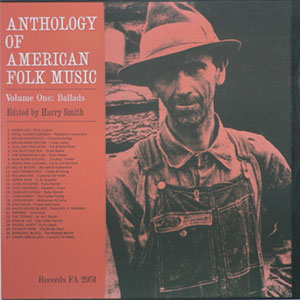
One of the more influential sources for this sort of music was Harry Smith's Anthology of American Folk Music. When the Anthology was re-released in the mid-1960s, the cover depicted a Depression-era labourer. This fit perfectly with the public perception of folk music as the advocate of social justice, but it misses what Smith was doing. The original cover art was taken from a work by the 17th century esotericist, Robert Fludd. It showed the hand of God reaching out to tune a giant monochord thus harmonising the various spheres. The liner notes quote Alesteir Crowley and Rudolph Steiner, and the albums are in different colours each corresponding to a basic element as its organising principle! The tracks and their placement in the album contribute to the potent sense of mystery. The effect as a whole is alchemy, not social protest. There are songs on the Anthology dealing with harsh working conditions, but they are there because they help to tell a story. They command our attention not because they call us to action, but because the picture they paint is so compelling and vivid that we can't help but be drawn into it.


A classic song from the Anthology, My Name is John Johanna taps into this mythic undercurrent. It transcends the genre of hardship songs because it tells a very individual story without a grand, unifying theory of worker's right vs. labour exploitation behind it. The story's use of myth makes its characters larger than life, in the best traditions of Twain and Dickens. It feels much older than it really is. Songs preaching social justice can get very tedious. Not because there is anything wrong with  striving for social justice (I think that we should all be striving for it), but because the message is heavy-handed. Art is subordinated to the message. The world created in John Johanna is not real, and it doesn't correlate to the world at large, but the imaginal effect is what means that it will never die, making its mix of the mundane and the mythic eminently relatable. 

Cain flying before Jehovah's Curse by Fernand Cormon

The song opens very intimately with the narrator- John Johanna- giving his name and a little of his story. A migrant worker, he's been everywhere and seen everything, but then he came to Arkansas. In the song Arkansas is not so much a real place as it is the definition of misery, a stand-in for Hell.
John Johanna gets a train ticket, travels to Arkansas, and runs into a friend. While the friend, like the narrator, has an ordinary name- Alan Catcher- he is also known by a nickname: Cain. The nickname is ominous, and Alan Catcher's physical appearance matches it. He is like a walking skeleton, seven feet two inches in height, and his long hair hangs down in rat-tails. The description emphasises his otherworldly nature, though he is fully human. In Western culture, Cain was often depicted as a wild man, whose very appearance is cursed. In short, nothing good can come from associating with the namesake of the original outcast. Alan Catcher claims to run the best hotel in Arkansas, so John Johanna follows him home. The rates are exorbitant, the food is inedible, and starvation is pictured on Catcher's pitiful face. John Johanna plans to live early the next morning, but Alan Catcher talks him into staying and working for him. The same rate as board, and all the beef he can chew. He promises that John Johanna will be transformed into a different (presumably better) man before he leaves. The work is draining swampland, and after six weeks of it, John Johanna feels so thin that he can hide behind a straw. The imagery of swamp has undertones of Hell or Purgatory, such as Dante's portrayal of the Styx, but at any rate, it is entirely unfit for human dwelling. Instead of Paradise, he found the primordial ooze with only swamp rabbits for companions. John Johanna leaves- how he raised the money is never explained- and he is indeed a changed man, but not for the better. The nearest he is willing to approach Arkansas is through a telescope. It is on that surreal note of a telescope that can see from New York to Arkansas that the song ends.


My name is John Johanna, I come from Buffalo town,
For nine long years I've traveled this wide, wide world around.
Through ups and downs and miseries and some good days I've saw,
But I never knew what misery was, till I went to Arkansas.

I went up to the station the operator to spy,
Told him my situation and where I wanted to ride,
Said, "Hand me down five dollars, lad, a ticket you shall draw
That'll land you safe by railway in the state of Arkansas."

I rode up to the station, I chanced to meet a friend.
Alan Catcher was his name, although they called him Cain.
His hair hung down in rat-tails below his under-jaw,
He said he run the best hotel in the state of Arkansas.

I followed my companion to his respected place,
Saw pity and starvation was pictured on his face.
His bread was old corn dodgers, his beef I could not chaw,
He charged me fifty cents a day in the state of Arkansas.

I got up that next morning to catch that early train.
He says, "Don't be in a hurry, lad, I have some land to drain.
You'll get your fifty cents a day and all that you can chaw,
You'll find yourself a different lad when you leave old Arkansas."

I worked six weeks for the son-of-a-gun, Alan Catcher was his name.
He stood seven feet two inches, as tall as any crane.
I got so thin on sassafras tea I could hide behind a straw,
You bet I was a different lad when I left old Arkansas.

Farewell you old swamp rabbits, also you dodger pills,
Likewise you walking skeletons, you old sassafras hills.
If you ever see my face again, I'll hand you down my paw,
I'll be looking through a telescope from home to Arkansas.


[1]http://www.interferenza.com/bcs/interw/66-jan.htm

[2]http://www.interferenza.com/bcs/interw/65-aug.htm

Saturday, September 21, 2013

Civil Servants Playing Cowboys and Indians: Absurd Moments in Espionage


Espionage is a dirty business. A dangerous business. A dull business. John le Carre brilliantly captured this in his 1963 novel, The Spy Who Came in From the Cold, as do the following lines from the equally remarkable 1965 screen adaptation. Spies are anything but moral philosophers.


On top of all that, espionage is frequently a spectacularly futile business. You recruit and train a spy, introduce the spy into the right circles, and then, in order to avoid detection and capture, they are hardly ever able to communicate lengthy messages back to the operational centre. If that weren't enough, the intelligence gathered is likely to be under-utilised, or even discarded.[1]

Yes, a damned, depressing business, however, there is a certain aspect of espionage that might be overlooked amidst it all- the absurdly comical. Yes, people really infiltrated Nazi-occupied Europe with evening wear under their wet-suits[2], and the CIA really did build a "cone of silence."[3]


One of the more absurd incidents in espionage history involves a curious mix of the real and the literary.


Though now obscure, William Le Queux almost single-handedly invented the romantic genre of the spy story of which Ian Fleming's James Bond is the ultimate representative. It is hard to imagine Bond without Le Queux's mix of sinister, yet exravagant, physically (or mentally) deformed villains, and outlandish plots.

"The hunchback now turned on me with a snarling expression like a tiger's. 

"Fool," he hissed, "you won't be warned," and, raising his arm, he made a sign with his hand. 

Almost instantly the crowd appeared to rise up en masse and to roll right over us, but as I stumbled backward, headlong from my foothold, I was astonished to see a man, got up to resemble me exactly in every feature, scramble on to my place on the upturned case, and in a voice that seemed my very own, to cry out to the auctioneer: "That, sir, is the most I can do. I now retire." And as a cheer broke out from the crowd he too skipped down instantly out of sight. 

"Ah, this is indeed treachery," I told myself. And, gripping my teeth hard, I let my fists go; next, with a mighty effort, I sprang forward to roll the surging human mob out of my path--to make my voice heard, to regain my old position, to take command of the situation again, for I heard the bids still mounting higher, higher, higher.

 In vain. 

Lord Fotheringay, who, I thought, loved me as a brother, was on me with a bound like a lion's, and catching me by the throat exerted all his force and hurled me backwards. 

 Next second I found myself caught up in other and even stronger arms, and, before I could utter aught save a muffled curse, I was flung head first into an empty piano case, the heavy lid of which was instantly closed on me--but not before I heard the hammer fall and the auctioneer call: "The deeds are Mr Peter Zouche's. The price is eighteen hundred pounds." I had been tricked![4]

Prior to the First World War, Germany had many agents at work in Great Britain.
One day, William Le Queux happened to be at Chatham, where he ran into Gustav Steinhauer, leader of Germany's espionage network in Britain. Years later, Steinhauer described the encounter.

 "One day while down at Chatham having a look at things in general and, as I imagined, effectively disguised with a false beard, who should I run across but William Le Queux, who had more than a nodding acquaintance with most of the spies in Europe. He at once warned the police and I had Melville on my track forthwith."[5]


Steinhauer's exploits, it seems, were later borrowed by Ian Fleming for Auric Goldfinger and his plot to steal the gold from Fort Knox.[6]


Melville was Sir William Melville, also known as "M," the first chief of Britain's MI5. Fleming adopted the initial (and much of Melville's personality) for Bond's chief[7]

So, what we have is the prototype of a character in the James Bond books pursuing the prototype of another character (a grown man wearing a patently false beard no less), after being tipped off by the pioneering author of the genre.


John le Carre (following in the footsteps of Somerset Maugham and Graham Greene) would latter shatter this genre of spy story with books like the aformentioned Spy Who Came in from the Cold, as well as The Looking Glass War, Tinker, Tailor, Soldier, Spy, and A Perfect Spy, but can the popularity of James Bond be denied? He is likely what immediately, almost subconsciously, comes to mind when the subject of spies is mentioned. After all, there is some truth to this image, too.


[1]For example, Abner Bennigsen AKA Goglidze- the Soviet agent who infiltrated a relatively high-ranking position in the SS- only made direct contact with his operators four or five times during the Second World War, and the valuable Messerschmidt plans that he acquired were completely ignored by the Red Army. http://berkovich-zametki.com/2006/Zametki/Nomer7/Heyfec1.htm

[2]See the excellent summary by Walker Wright of the Peter Tazelaar affair.

[3]"OTS designed a new type of “secure room” that improved the confi dence of the CIA that their operational discussions  were protected from KGB eavesdropping. The special room, including chairs and tables, was constructed entirely of clear plastic to expose any electronic listening devices, or “bugs.” In theory, it was comparable to the fictional “cone of silence” from the 1960s television show Get Smart." Robert Wallace, H. Keith Melton, Henry R. Schlesinger, Spycraft: The Secret History of the CIA's Spytechs, from Communism to Al-Qaeda (Penguin Group Inc.: New York, 2008), 494.

[4]William Le Queux, The Hunchback of Westminster (Methuen & Co.: London, 1904), 17-18. http://archive.org/details/hunchbackofwestm00lequ

[5]Gustav Steinhauer, Steinhauer: The Kaiser's Master Spy (Appleton: New York, 1931), 62. See also Stella Rimington's introduction to the 2007 edition of the Greene brothers' The Spy's Bedside Book. Both it and the book in general are a treasure trove of espionage stories, fictional and real. Selections from Le Queux feature prominently.

[6]Goldfinger, of course, has other, self-evident prototypes (such as the architect Erno Goldfinger), but historian Andrew Cook has made a good case for Steinhauer.

[7]Andrew Cook, M: MI5's First Spymaster (Tempus Publishing: Stroud, 2004). See also http://news.bbc.co.uk/2/hi/uk_news/northern_ireland/7163329.stm

Wednesday, September 4, 2013

Melissa Annetta: Vladimir Nabokov at the Little Cottonwood

I have a delightful Russian-language anthology of Vladimir Nabokov miscellania, which I acquired in Utah, of all places. For me, that makes a fun little Nabokov connection with Utah even funner.

The following is taken entirely from Will South's book, Andy Warhol Slept Here? (there are lots of other fun stories in the book) which Signature Books has generally posted free, in its entirety, on their website.
http://signaturebookslibrary.org/?p=21175

                                           *************************

Vladimir Nabokov was a twice-exiled writer and scientist; first from his native Russia during the Bolshevik Revolution, then from Paris in advance of the Nazi invasion of Western Europe. He arrived in America in 1940, and over the next two decades established himself as one of the most brilliant authors of the twentieth century.

Nabokov struggled financially in America for years, supporting his wife, his young son, and himself on his wages from teaching Russian literature at Wellesley College and later at Cornell. Then, in 1955, he achieved stunning success, artistically and financially, with the publication of the sumptuous and sinister novel Lolita. A classic story saturated with derangement, romance, and fate, Lolita remains a literary force that reverberates through the American cultural consciousness.

Long before the publication of Lolita, Nabokov’s word magic caught the attention of University of Utah professor Brewster Ghiselin, who invited Nabokov to the University’s Annual Writers Conference. Nabokov accepted. His only serious concern about attending, he expressed to Ghiselin, was hygienic: “Last but not least—will I have a private bath or shower?” He and his son, Dmitri, also managed to find time during the conference to play some tennis with a member of the local literati, Wallace Stegner.

Nabokov’s first and perhaps more meaningful visit to Utah, however, came very early in his American career. His publisher, James Laughlin, owned the Alta Lodge in the Wasatch mountains. Nabokov asked Laughlin if he could stay at the hotel, which was largely empty due to the war.

Navokov
Vladimir Nabokov with University of Utah students in 1949.
Photograph courtesy Special Collections, University of Utah Marriott Library.

In June 1943 Vladimir was able to indulge the passion that occupied him as much as writing: butterfly collecting. Nabokov was a serious lepidopterist and worked during this period at the Harvard Entomological Museum. At Alta he roamed what he called “the tapering lines of firs on the slopes amid a grayish green haze of aspens” in search of rare winged species. According to biographer Brian Boyd:

For Nabokov, Utah was a fortunate choice: one of the few states in which little butterfly collecting had been done, and with mountain ranges isolated by deserts and therefore likely to have evolved new species. Despite a severe climate with icy winds and noisy thunderstorms, he would walk along the valleys and mountain slopes, whenever the sun came out, from twelve to eighteen miles a day, clad only in shorts and tennis shoes, offering a generous target for gadflies. He wanted to rediscover the haunts of Melissa Annetta, a long-lost subspecies of the Lycaeides genus that he had been working on the previous winter, and with the help of nine-year-old Dmitri, he found it on lupine among firs on both sides of the Little Cottonwood River, not far from Alta.

Nabokov family
Vladimir Nabokov in Salt Lake City with son, Dimitri, and wife, Véra.

Tuesday, September 3, 2013

A Gun For Sale: Mormons and Mohammedans


 I am LDS, so it is rather fun to come across unexpected references to Mormons in unrelated books.

One of the pivotal scenes in A Gun For Sale, Graham Greene's 1936 novel of political assassination and revenge, is the gas practice in the streets of Nottwich.

Raven, the hare-lipped hired killer, tracks down those who double-crossed him to the town of Nottwich. Since Europe has been brought to the brink of war by his assassination of the minister of an unnamed country, military drills are taking place throughout England. This particular one allows him to evade police pursuit and take his revenge.

In the 1942 film noir classic, This Gun For Hire, the story is transposed to wartime San Francisco. The gas-mask sequence begins at 1:12:42.
 
In the book, several medical students decide to rag conchies- conscientious objectors- and everyone not wearing a gas-mask. "What they wanted were people who cared so little about their country that they wouldn't even take the trouble to put on a gas-mask."[1] After a particularly violent episode where they trash the room of a bookish colleague, the students come across a senile old woman.

Almost immediately they picked up an old woman. She didn't in the least know what it was all about. She thought it was a street collection and offered them a penny. They told her she had to come along to the hospital; they were very courteous and one offered to carry her basket; they reacted from violence to a more than usual gentility. She laughed at them. She said, 'Well I never, what you boys will think up next!' and when one took her arm and began to lead her gently up the street, she said, 'Which of you's Father Christmas?' Buddy didn't like that: it hurt his dignity: he had suddenly been feeling rather noble: 'women and children first': 'although bombs were falling all round he brought the woman safely...' He stood still and let the others go on up the street with the old woman; she was having the time of her life; she cackled and dug them in the ribs: her voice carried a long distance in the cold air. She kept on telling them to ' take off them things and play fair', and just before they turned a corner out of sight she was calling them Mormons. She meant Mohammedans, because she had an idea that Mohammedans went about with their faces covered up and had a lot of wives. An aeroplane zoomed overhead and Buddy was alone in the street with the dead and dying until Mike appeared. Mike said he had a good idea. Why not pinch the mummy in the Castle and take it to the hospital for not wearing a gas-mask?[2]

 Buddy, the medical students' ringleader, then chases after another man without a gas-mask, but this time it is Raven...


[1]Graham Greene, A Gun For Sale: An Entertainment, 1936, p. 142.

 [2]Greene, Gun For Sale, p. 146.

Wednesday, July 3, 2013

Franz Kafka's Personal Tragedy


Today is Franz Kafka’s 130th birthday, and as good a reason as any to write on some of his autobiographical material. 

In 1919 he wrote a letter to his father, a letter that was never delivered. It was a brutally honest, unflinching effort to analyse and rebuild their relationship.

"You really had brought some traces of Judaism with you from the ghetto-like village community; it was not much and it dwindled a little more in the city and during your military service; but still, the impressions and memories of your youth did just about suffice for some sort of Jewish life, especially since you did not need much help of that kind, but came of robust stock and could personally scarcely be shaken by religious scruples unless they were strongly mixed with social scruples. Basically the faith that ruled your life consisted in your believing in the unconditional rightness of the opinions of a certain class of Jewish society, and hence actually, since these opinions were part and parcel of your own nature, in believing in yourself. Even in this there was still Judaism enough, but it was too little to be handed on to the child; it all dribbled away while you were passing it on. In part, it was youthful memories that could not be passed on to others; in part, it was your dreaded personality."[1]

The letter reflects Kafka's personal tragedy- his strained relationship with his father, and his feeling of alienation- but it is also emblematic of his generation's experience. Kafka himself recognised that. "The whole thing is, of course, no isolated phenomenon. It was much the same with a large section of this transitional generation of Jews, which had migrated from the still comparatively devout countryside to the cities."
From the 1870s onward, Bohemian Jews witnessed an interesting phenomenon. A significant portion of Jews from the Bohemian villages moved to Prague, set up business ventures, prospered, and integrated themselves to a large degree into Czech and German society. Their attitude towards their religion grew lax, to say the least, and children of Kafka's generation grew up with a minimal, nominal Jewish identity at best. Synagogue attendance could have been as infrequent as a few days a year. "Four days a year you went to the synagogue, where you were, to say the least, closer to the indifferent than to those who took it seriously, patiently went through the prayers as a formality, sometimes amazed me by being able to show me in the prayer book the passage that was being said at the moment..." That was the synagogue. The situation at the Kafka household was "even poorer." The only thing observed was the first Passover Seder, which, "more and more developed into a farce, with fits of hysterical laughter, admittedly under the influence of the growing children. (Why did you have to give way to that influence? Because you had brought it about.)"
Even when they attended synagogue services, it seemed to the young Kafka a "purely social event," his father going through mere motions. Kafka's father, Franz later realised, did have a genuine attachment of sorts to Judaism, but it was related to childhood nostalgia and a sense of social status more than any inherent religious meanings or values.
"It was also impossible to make a child, overacutely observant from sheer nervousness, understand that the few flimsy gestures you performed in the name of Judaism, and with an indifference in keeping with their flimsiness, could have any higher meaning. For you they had meaning as little souvenirs of earlier times, and that was why you wanted to pass them on to me, but since they no longer had any intrinsic value even for you could do this only through persuasion or threat; on the one hand, this could not be successful, and on the other, it had to make you very angry with me on account of my apparent obstinacy, since you did not recognize the weakness of your position in this."
Kafka wryly summed up the lack of a vibrant, meaningful, and spiritual experience of Judaism, when he said, "this was the religious material that was handed on to me"
Is it any wonder that Kafka then remarked, "how one could do anything better with that material than get rid of it as fast as possible."
What Kafka's loss of identity boils down to is that a scarcely observant father could not browbeat or guilt his son into accepting a faith to which the former attached so little meaning. Kafka later grew closer to his Jewish roots by the influence of a friend, Jiri Langer. Langer came from a similar background, but ran away from home to become a follower for a while of the Hasidic Rebbe of Belz. By then, however, time was running out and Kafka never entirely regained neither faith nor identity before his untimely death.


Wednesday, June 5, 2013

Harry Lime and a Very Human Evil


Much of the black market can be relatively innocuous. It provides ordinairy people with at least some sort of access to necessities and luxuries that they might not otherwise be able to obtain. This is particularly true of wartime and occupied economies where almost everything is in short supply.

The subject of Graham Greene's The Third Man, however, is far more nefarious than trade in bootleg sugar and tires- it is a penicilin racket. The charming rogue Harry Lime and his partners, the smarmy Baron Kurtz and the supercillious Dr. Winkler, sell the antibiotic to civilian hospitals in occupied Vienna. Only the occupying militaries have access to it, and the antibiotic is in high demand. In order to increase their profits, Harry Lime's gang dilutes the penicilin with coloured water and sand, an action which at best renders future treatment ineffective, but most often leads to amputation, derangement, or death.

"But perhaps what horrified me most was visiting the children's hospital here. They had bought some of this penicillin for use against meningitis. A number of children simply died, and a number went off their heads. You can see them now in the mental ward."[1]

 This is a cold, cynical, vile act motivated by large profits. It is sickening, it is monstrous, it is inhuman, and it is unthinkable. Or so it would seem.

 When Harry Lime is confronted at the Ferris wheel by his best friend, Rollo Martins, the following exchange ensues.

"Martins said, "Have you ever visited the children's hospital? Have you seen any of your victims?"
Harry took a look at the toy landscape below and came away from the door. "I never feel quite safe in these things," he said. He felt the back of the door with his hand, as though he were afraid that it might fly open and launch him into that iron-ribbed space. "Victims?" he asked. "Don't be melodramatic, Rollo, look down there," he went on, pointing through the window at the people moving like black flies at the base of the Wheel. "Would you really feel any pity if one of those dots stopped moving-for ever? If I said you can have twenty thousand pounds for every dot that stops, would you really, old man, tell me to keep my money-without hesitation? or would you calculate how many dots you could afford to spare? Free of income tax, old man. Free of income tax." He gave his boyish conspiratorial smile, "It's the only way to save nowadays."
"Couldn't you have stuck to tyres?"
"Like Cooler? No, I've always been ambitious. "But they can't catch me, Rollo, you'll see. I'll pop up again. You can't keep a good man down." The car swung to a standstill at the highest point of the curve and Harry turned his back and gazed out of the window. Martins thought: one good shove and I could break the glass, and he pictured the body dropping among the flies. He said, "You know the police are planning to dig up your body: what will they find?"
"Harbin," Harry replied with simplicity. He turned away from the window and said, "Look at the sky."
The car had reached the top of the Wheel and hung there motionless, while the stain of the sunset ran in streaks over the wrinkled papery sky beyond the black girders...
"I'd like to knock you through the window."
"But you won't, old man. Our quarrels never last long. You remember that fearful one in the Monaco, when we swore we were through. I'd trust you anywhere, Rollo. Kurtz tried to persuade me not to come but I know you. Then he tried to persuade me to, well, arrange an accident. He told me it would be quite easy in this car."
"Except that I'm the stronger man."
"But I've got the gun. You don't think a bullet wound would show when you hit that ground?" Again the car began to move, sailing slowly down, until the flies were midgets, were recognisable human beings. "What fools we are, Rollo, talking like this, as if I'd do that to you-or you to me." He turned his back and leant his face against the glass. One thrust… "How much do you earn a year with your Westerns, old man?"
"A thousand."
"Taxed. I earn thirty thousand free. It's the fashion. In these days, old man, nobody thinks in terms of human beings, Governments don't, so why should we? They talk of the people and the proletariat, and I talk of the mugs. It's the same thing. They have their five year plans and so have I."
"You used to be a Catholic."
"Oh, I still believe, old man. In God and Mercy and all that. I'm not hurting anybody's soul by what I do. The dead are happier dead. They don't miss much here, poor devils," he added with that odd touch of genuine pity, as the car reached the platform and the faces of the doomed-to-be-victims, the tired pleasure-hoping Sunday faces, peered in at them..."[2]

What is particularly chilling about Harry Lime is that he still cares (somewhat) about (certain) people, he feels pity, and believes in God, yet makes a very profitable living from swindling children's hospitals. Innocents die, and Harry knows. This is a very human evil, an evil that can be rationalised and made to fit- or improve- one's lifestyle. Harry isn't even exceptionally fearless or desperate, and he certainly isn't certifiably insane. What Graham Greene does best, in my opinion, is to avoid black and white thinking when it comes to people, all the while never forgetting that there clearly is both good and evil, right and wrong. Evil is scary not because it is is distant and alien, but because it occupies the same sphere as we do. It could be present in our best friends, in our lovers, or scariest thought of all- it could even be part of ourselves.
 
This post would be incomplete without the equivalent scene from the movie, though in my opinion Orson Welles' famous quip regarding Switzerland subtly changes the scene's focus.
That, however, is a different topic for a different time.


[1]Graham Greene, "The Third Man and The Fallen Idol," Penguin Books, 1977, p. 80-81.
 
[2]"Third Man," p. 104-107.

Friday, May 10, 2013

From Tolstoy to Twitter


It is a common phenomenon in our modern world for people to be famous for being famous. Their message and public aura inseparable from each other, their celebrity lending their opinions authority. 
As an example of such, a recent poll rated the actors Tom Hanks and Sandra Bullock as the two people most trusted by Americans.[1] Social media has vastly magnified this tendency in recent years. If the medium, as Marshal Macluhan suggested, is the message, then in this case the message is the message-bearer themselves.
The Russian-born British thinker Alexander Boot traces the roots of the phenomenon to none other than Count Leo Nikolaevitch Tolstoy.


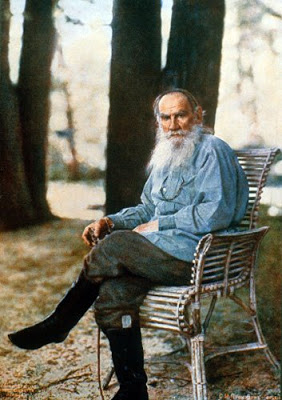
Tolstoy was arguably the best-known personality of the early 20th century, his influence reaching such widely disparate groups as European anarchists; Russian peasents and sectarians; English writers; Zionist settlers; Indian nationalists; and Mormons.

"Another contribution Tolstoy made to modernity was his pioneering use of barely nascent mass media. Not for him the contemplative solitude of a Kant or a Nietzsche. Tolstoy consciously built up his public personality as an important part of his message to mankind, to a point where the personality became most of the message. The first color photograph taken in Russia was of him. His was the crackling voice on the first Russian phonograph record. His disheveled visage, deliberately modeled on the crude public perception of God’s appearance, flashed through the first Russian newsreels and countless films to follow.
Tolstoy’s disciples Chertkov and Biryukov presaged modern PR techniques by keeping the world’s press informed of every new twist in the great man’s life, while Tolstoy himself never turned down a media opportunity. And the world was already sufficiently corrupt not to sense the incongruity of a back-to-nature prophet ostensibly rejecting modernity, while at the same time chasing publicity wherever he could find it. Nor could the world see that great artistic talent, or indeed expertise in any area, does not automatically make its possessor an authority on everything else. Today this credulity has been pushed to its extreme.
We no longer cringe when a popular actor pontificates on the global ramifications of warm weather or when a tattooed footballer with a useful left foot tells us we “shouldn’t of went” into Iraq.
Such people are of course entitled to their opinions. But only these days do they feel entitled to an audience."[2]

 One could perhaps soften Boot's remark on a corrupt world by noting the novelty factor that such technology certainly possessed, and while Tolstoy hardly ranks among my favourite writers, I'm actually rather grateful that the scratchy old recording does exist. A voice offers me a way to connect with the past that goes beyond the images that I form from text and photographs.
Would the world have been a better place without Tolstoy's contribution? Perhaps. All that could really be said is that the world would have been a different place.


[1]http://www.mirror.co.uk/3am/us-gossip/tom-hanks-named-most-trusted-1873455

[2]Alexander Boot, God and Man According to Tolstoy, 2009, p. 6. Boot's book is polemic, but it is still the most extensive treatment of Tolstoy's religious philosophy.