Wednesday, July 3, 2013

Franz Kafka's Personal Tragedy


Today is Franz Kafka’s 130th birthday, and as good a reason as any to write on some of his autobiographical material. 

In 1919 he wrote a letter to his father, a letter that was never delivered. It was a brutally honest, unflinching effort to analyse and rebuild their relationship.

"You really had brought some traces of Judaism with you from the ghetto-like village community; it was not much and it dwindled a little more in the city and during your military service; but still, the impressions and memories of your youth did just about suffice for some sort of Jewish life, especially since you did not need much help of that kind, but came of robust stock and could personally scarcely be shaken by religious scruples unless they were strongly mixed with social scruples. Basically the faith that ruled your life consisted in your believing in the unconditional rightness of the opinions of a certain class of Jewish society, and hence actually, since these opinions were part and parcel of your own nature, in believing in yourself. Even in this there was still Judaism enough, but it was too little to be handed on to the child; it all dribbled away while you were passing it on. In part, it was youthful memories that could not be passed on to others; in part, it was your dreaded personality."[1]

The letter reflects Kafka's personal tragedy- his strained relationship with his father, and his feeling of alienation- but it is also emblematic of his generation's experience. Kafka himself recognised that. "The whole thing is, of course, no isolated phenomenon. It was much the same with a large section of this transitional generation of Jews, which had migrated from the still comparatively devout countryside to the cities."
From the 1870s onward, Bohemian Jews witnessed an interesting phenomenon. A significant portion of Jews from the Bohemian villages moved to Prague, set up business ventures, prospered, and integrated themselves to a large degree into Czech and German society. Their attitude towards their religion grew lax, to say the least, and children of Kafka's generation grew up with a minimal, nominal Jewish identity at best. Synagogue attendance could have been as infrequent as a few days a year. "Four days a year you went to the synagogue, where you were, to say the least, closer to the indifferent than to those who took it seriously, patiently went through the prayers as a formality, sometimes amazed me by being able to show me in the prayer book the passage that was being said at the moment..." That was the synagogue. The situation at the Kafka household was "even poorer." The only thing observed was the first Passover Seder, which, "more and more developed into a farce, with fits of hysterical laughter, admittedly under the influence of the growing children. (Why did you have to give way to that influence? Because you had brought it about.)"
Even when they attended synagogue services, it seemed to the young Kafka a "purely social event," his father going through mere motions. Kafka's father, Franz later realised, did have a genuine attachment of sorts to Judaism, but it was related to childhood nostalgia and a sense of social status more than any inherent religious meanings or values.
"It was also impossible to make a child, overacutely observant from sheer nervousness, understand that the few flimsy gestures you performed in the name of Judaism, and with an indifference in keeping with their flimsiness, could have any higher meaning. For you they had meaning as little souvenirs of earlier times, and that was why you wanted to pass them on to me, but since they no longer had any intrinsic value even for you could do this only through persuasion or threat; on the one hand, this could not be successful, and on the other, it had to make you very angry with me on account of my apparent obstinacy, since you did not recognize the weakness of your position in this."
Kafka wryly summed up the lack of a vibrant, meaningful, and spiritual experience of Judaism, when he said, "this was the religious material that was handed on to me"
Is it any wonder that Kafka then remarked, "how one could do anything better with that material than get rid of it as fast as possible."
What Kafka's loss of identity boils down to is that a scarcely observant father could not browbeat or guilt his son into accepting a faith to which the former attached so little meaning. Kafka later grew closer to his Jewish roots by the influence of a friend, Jiri Langer. Langer came from a similar background, but ran away from home to become a follower for a while of the Hasidic Rebbe of Belz. By then, however, time was running out and Kafka never entirely regained neither faith nor identity before his untimely death.


Wednesday, June 5, 2013

Harry Lime and a Very Human Evil


Much of the black market can be relatively innocuous. It provides ordinairy people with at least some sort of access to necessities and luxuries that they might not otherwise be able to obtain. This is particularly true of wartime and occupied economies where almost everything is in short supply.

The subject of Graham Greene's The Third Man, however, is far more nefarious than trade in bootleg sugar and tires- it is a penicilin racket. The charming rogue Harry Lime and his partners, the smarmy Baron Kurtz and the supercillious Dr. Winkler, sell the antibiotic to civilian hospitals in occupied Vienna. Only the occupying militaries have access to it, and the antibiotic is in high demand. In order to increase their profits, Harry Lime's gang dilutes the penicilin with coloured water and sand, an action which at best renders future treatment ineffective, but most often leads to amputation, derangement, or death.

"But perhaps what horrified me most was visiting the children's hospital here. They had bought some of this penicillin for use against meningitis. A number of children simply died, and a number went off their heads. You can see them now in the mental ward."[1]

 This is a cold, cynical, vile act motivated by large profits. It is sickening, it is monstrous, it is inhuman, and it is unthinkable. Or so it would seem.

 When Harry Lime is confronted at the Ferris wheel by his best friend, Rollo Martins, the following exchange ensues.

"Martins said, "Have you ever visited the children's hospital? Have you seen any of your victims?"
Harry took a look at the toy landscape below and came away from the door. "I never feel quite safe in these things," he said. He felt the back of the door with his hand, as though he were afraid that it might fly open and launch him into that iron-ribbed space. "Victims?" he asked. "Don't be melodramatic, Rollo, look down there," he went on, pointing through the window at the people moving like black flies at the base of the Wheel. "Would you really feel any pity if one of those dots stopped moving-for ever? If I said you can have twenty thousand pounds for every dot that stops, would you really, old man, tell me to keep my money-without hesitation? or would you calculate how many dots you could afford to spare? Free of income tax, old man. Free of income tax." He gave his boyish conspiratorial smile, "It's the only way to save nowadays."
"Couldn't you have stuck to tyres?"
"Like Cooler? No, I've always been ambitious. "But they can't catch me, Rollo, you'll see. I'll pop up again. You can't keep a good man down." The car swung to a standstill at the highest point of the curve and Harry turned his back and gazed out of the window. Martins thought: one good shove and I could break the glass, and he pictured the body dropping among the flies. He said, "You know the police are planning to dig up your body: what will they find?"
"Harbin," Harry replied with simplicity. He turned away from the window and said, "Look at the sky."
The car had reached the top of the Wheel and hung there motionless, while the stain of the sunset ran in streaks over the wrinkled papery sky beyond the black girders...
"I'd like to knock you through the window."
"But you won't, old man. Our quarrels never last long. You remember that fearful one in the Monaco, when we swore we were through. I'd trust you anywhere, Rollo. Kurtz tried to persuade me not to come but I know you. Then he tried to persuade me to, well, arrange an accident. He told me it would be quite easy in this car."
"Except that I'm the stronger man."
"But I've got the gun. You don't think a bullet wound would show when you hit that ground?" Again the car began to move, sailing slowly down, until the flies were midgets, were recognisable human beings. "What fools we are, Rollo, talking like this, as if I'd do that to you-or you to me." He turned his back and leant his face against the glass. One thrust… "How much do you earn a year with your Westerns, old man?"
"A thousand."
"Taxed. I earn thirty thousand free. It's the fashion. In these days, old man, nobody thinks in terms of human beings, Governments don't, so why should we? They talk of the people and the proletariat, and I talk of the mugs. It's the same thing. They have their five year plans and so have I."
"You used to be a Catholic."
"Oh, I still believe, old man. In God and Mercy and all that. I'm not hurting anybody's soul by what I do. The dead are happier dead. They don't miss much here, poor devils," he added with that odd touch of genuine pity, as the car reached the platform and the faces of the doomed-to-be-victims, the tired pleasure-hoping Sunday faces, peered in at them..."[2]

What is particularly chilling about Harry Lime is that he still cares (somewhat) about (certain) people, he feels pity, and believes in God, yet makes a very profitable living from swindling children's hospitals. Innocents die, and Harry knows. This is a very human evil, an evil that can be rationalised and made to fit- or improve- one's lifestyle. Harry isn't even exceptionally fearless or desperate, and he certainly isn't certifiably insane. What Graham Greene does best, in my opinion, is to avoid black and white thinking when it comes to people, all the while never forgetting that there clearly is both good and evil, right and wrong. Evil is scary not because it is is distant and alien, but because it occupies the same sphere as we do. It could be present in our best friends, in our lovers, or scariest thought of all- it could even be part of ourselves.
 
This post would be incomplete without the equivalent scene from the movie, though in my opinion Orson Welles' famous quip regarding Switzerland subtly changes the scene's focus.
That, however, is a different topic for a different time.


[1]Graham Greene, "The Third Man and The Fallen Idol," Penguin Books, 1977, p. 80-81.
 
[2]"Third Man," p. 104-107.

Friday, May 10, 2013

From Tolstoy to Twitter


It is a common phenomenon in our modern world for people to be famous for being famous. Their message and public aura inseparable from each other, their celebrity lending their opinions authority. 
As an example of such, a recent poll rated the actors Tom Hanks and Sandra Bullock as the two people most trusted by Americans.[1] Social media has vastly magnified this tendency in recent years. If the medium, as Marshal Macluhan suggested, is the message, then in this case the message is the message-bearer themselves.
The Russian-born British thinker Alexander Boot traces the roots of the phenomenon to none other than Count Leo Nikolaevitch Tolstoy.


Tolstoy was arguably the best-known personality of the early 20th century, his influence reaching such widely disparate groups as European anarchists; Russian peasents and sectarians; English writers; Zionist settlers; Indian nationalists; and Mormons.

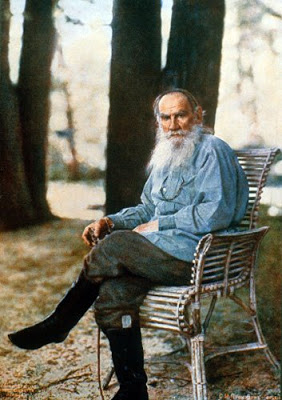
"Another contribution Tolstoy made to modernity was his pioneering use of barely nascent mass media. Not for him the contemplative solitude of a Kant or a Nietzsche. Tolstoy consciously built up his public personality as an important part of his message to mankind, to a point where the personality became most of the message. The first color photograph taken in Russia was of him. His was the crackling voice on the first Russian phonograph record. His disheveled visage, deliberately modeled on the crude public perception of God’s appearance, flashed through the first Russian newsreels and countless films to follow.
Tolstoy’s disciples Chertkov and Biryukov presaged modern PR techniques by keeping the world’s press informed of every new twist in the great man’s life, while Tolstoy himself never turned down a media opportunity. And the world was already sufficiently corrupt not to sense the incongruity of a back-to-nature prophet ostensibly rejecting modernity, while at the same time chasing publicity wherever he could find it. Nor could the world see that great artistic talent, or indeed expertise in any area, does not automatically make its possessor an authority on everything else. Today this credulity has been pushed to its extreme.
We no longer cringe when a popular actor pontificates on the global ramifications of warm weather or when a tattooed footballer with a useful left foot tells us we “shouldn’t of went” into Iraq.
Such people are of course entitled to their opinions. But only these days do they feel entitled to an audience."[2]

 One could perhaps soften Boot's remark on a corrupt world by noting the novelty factor that such technology certainly possessed, and while Tolstoy hardly ranks among my favourite writers, I'm actually rather grateful that the scratchy old recording does exist. A voice offers me a way to connect with the past that goes beyond the images that I form from text and photographs.
Would the world have been a better place without Tolstoy's contribution? Perhaps. All that could really be said is that the world would have been a different place.


[1]http://www.mirror.co.uk/3am/us-gossip/tom-hanks-named-most-trusted-1873455

[2]Alexander Boot, God and Man According to Tolstoy, 2009, p. 6. Boot's book is polemic, but it is still the most extensive treatment of Tolstoy's religious philosophy.

Monday, April 1, 2013

The Atonement as a Symbol of War's Tragedy

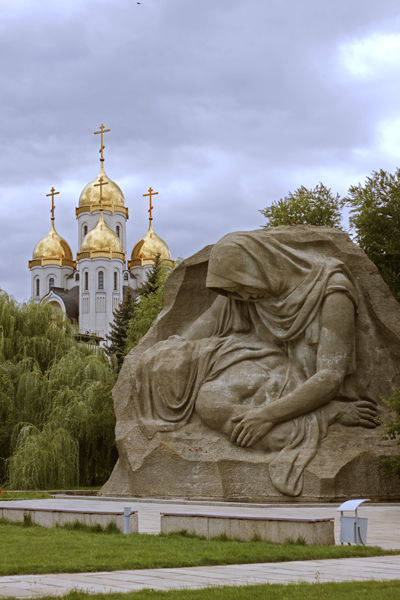
When I lived in Volgograd, the former Stalingrad, I was able twice to visit the war memorial at Mamaev Kurgan. This hill was one of the key bastions in the defence mounted by a city that would not die. Thousands left their lives on the hill's slopes. Films like "Enemy at the Gates" can never come even close to conveying the horror of a city of ruins carpeted by red snow- red from mixing with blood and gore. As just one account, the aunt of a friend was in her mid-twenties when sent to clean up the city. Her hair went completely white with shock.

Though there are many sculptures on Mamaev Kurgan- from heroic soldiers to the enormous Motherland modelled after the Nike of Samothrace- I found none as moving as the depiction of a mother cradling a dead son in her arms.


The idea was a bold one for a Soviet sculptor, as it comes from a traditional Christian genre- the Pietà. A Pietà typically depicts the Virgin Mary holding her son the Christ after He was taken down from the cross. It is a powerful expression of grief which allows one to remember that Christ was human, too. He had family and He had friends. These were real relationships, that cannot be emphasised enough. Yes, He rose triumphantly from the the tomb on the third day, but His death must have shattered His mother's heart.


This is not the first time that Christ's atonement has been used to symbolise the tragedy and devastation that is war. Aleksei Nikolaevich Tolstoy entitled his trilogy of novels depicting the destruction of the old Russian intelligencia in the civil war Khozhdenie Po Mukam, the Russian equivalent of the Latin term Via Dolorosa. This Path of Suffering is the one traversed by Christ whilst He carried the cross.

In English literature we find the atonement used in Kipling's poem, Gethsemane.

The Garden called Gethsemane
  In Picardy it was,
And there the people came to see
  The English soldiers pass.
We used to pass - we used to pass
  Or halt, as it might be,
And ship our masks in case of gas
  Beyond Gethsemane.

The Garden called Gethsemane,
  It held a pretty lass,
But all the time she talked to me
  I prayed my cup might pass.
The officer sat on the chair,
  The men lay on the grass,
And all the time we halted there
  I prayed my cup might pass.

It didn't pass - it didn't pass
  It didn't pass from me.
I drank it when we met the gas
  Beyond Gethsemane!


Gas was a new horror on the battlefields of the First World War. You could never be quite sure as to where it had fallen, and it could remain stuck to clothing and other items for hours. If your skin became exposed to gas, it would burn and blister horribly, and worse, if it reached your eyes!
My own brief exposure to mustard gas came during my service as a conscript in the IDF. We had to undergo chemical warfare training, involving us entering a small building sprayed with gas. We had to remain there a few seconds before we could don our masks. My experience did not last long at all, and were cleaned up right away, but I'll never forget how sick I felt the remainder of the day, how my skin itched and my eyes burned. It was then that I remembered this poem.
Gas was the cross upon which Kipling's soldiers were crucified. It was the horror that they could not be spared.


In 1918, Kipling lost his son, Jack, at Loos. The body was never found during Kipling's lifetime. A few years after the war, Kipling wrote what I consider his masterpiece- The Gardner.

Helen Turrell raised her nephew, Michael, by herself, until he was called up to the front and killed. When at last his grave has been discovered, she travels to visit it.

"Next morning Mrs Scarsworth left early on her round of commissions, and Helen walked alone to Hagenzeele Third. The place was still in the making, and stood some five or six feet above the metalled road, which it flanked for hundreds of yards. Culverts across a deep ditch served for entrances through the unfinished boundary wall. She climbed a few woodenfaced earthen steps and then met the entire crowded level of the thing in one held breath. She did not know that Hagenzeele Third counted twenty-one thousand dead already. All she saw was a merciless sea of black crosses, bearing little strips of stamped tin at all angles across their faces. She could distinguish no order or arrangement in their mass; nothing but a waist-high wilderness as of weeds stricken dead, rushing at her. She went forward, moved to the left and the right hopelessly, wondering by what guidance she should ever come to her own. A great distance away there was a line of whiteness. It proved to be a block of some two or three hundred graves whose headstones had already been set, whose flowers were planted out, and whose new-sown grass showed green. Here she could see clear-cut letters at the ends of the rows, and, referring to her slip, realized that it was not here she must look.

A man knelt behind a line of headstones - evidently a gardener, for he was firming a young plant in the soft earth. She went towards him, her paper in her hand. He rose at her approach and without prelude or salutation asked: "Who are you looking for?"

"Lieutenant Michael Turrell - my nephew", said Helen slowly and word for word, as she had many thousands of times in her life.

The man lifted his eyes and looked at her with infinite compassion before he turned from the fresh-sown grass toward the naked black crosses.

"Come with me", he said, "and I will show you where your son lies."

When Helen left the Cemetery she turned for a last look. In the distance she saw the man bending over his young plants; and she went away, supposing him to be the gardener."

The imagery is that of the Gospels, when Mary Magdalene mistakes the risen Christ for the gardner.
Helen Turrell's miracle differs from Mary Magdalene's. There is no empty tomb, the graves are depressingly full, and her illegitimate son has not returned to life, but she has found a miracle nonetheless. The gardner revealed the hidden truth that had crippled her for years, and revealed it gently, out of pure compassion. For once in her life she did not need to pretend, did not need to distance herself, but could give free expression to her sorrow. She could be a mother, not an aunt. This is why she leaves the cemetery believing the man to be Christ.
When combined with love, truth sets us free.

While at first glance the atonement doesn't to have much to do with war, God's greatest suffering and tragedy is a powerful symbol giving expression to the horror and sorrow caused by war.